Inlays vs. Fillings vs. Crowns: How Dentists Choose the Right Restoration in Cathedral City
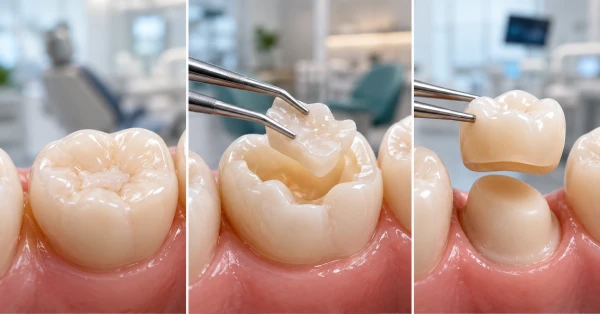
If you have a cavity, a cracked cusp, or an older filling that is starting to fail, the next question is usually, "Do I just need another filling, or do I need something stronger?" Patients researching inlays in Cathedral City are often trying to avoid two extremes: a restoration that is too small (and fails early) or treatment that is more than the tooth truly needs.
At Smile Guru, Dr. Keerthi Senthil and our team help patients compare options based on what matters most: how much healthy tooth is left, where the damage is located, and how much chewing force that tooth takes every day.
TL;DR - A Simple Way To Choose Between Three Options
Fillings, inlays/onlays, and crowns each solve different problems. The "best" choice is the one that protects your tooth predictably while preserving as much natural structure as possible.
- Filling: best for small-to-moderate decay when most of the tooth is intact.
- Inlay/onlay: best when damage is bigger than a filling can support, but full coverage is not necessary.
- Crown: best when the tooth is significantly weakened, cracked, or needs full-coverage protection.
- What to ask: "How much tooth structure is missing, and where are the stress points when I bite?"
Why Dentists Do Not Automatically Choose "The Biggest Fix"
A common misconception is that a crown is always the "strongest" and therefore always the right answer. In reality, the decision is about risk management: reducing the chance of the tooth fracturing, the restoration leaking, or the bite feeling "off" over time.
One clinical observation we see often is that a restoration fails not because it was "bad," but because it was asked to do too much. For example, a large chewing-surface filling on a back tooth can work well for some patients, but if the tooth has thin walls or biting forces are high, choosing a stronger option earlier may prevent a broken tooth later.
Option 1: Dental Fillings (When "Small and Simple" Is Enough)
A filling restores a tooth after decay or minor damage is removed. If the cavity is relatively small and the remaining tooth structure is strong, a filling is often the most conservative approach.
If you want a deeper overview of materials and what to expect, see our page on dental fillings.
When a Filling Usually Makes Sense
- Small-to-moderate cavities that do not weaken the cusps (the biting "points" of the tooth)
- Minor chipping that does not involve a large portion of the chewing surface
- Areas where there is enough enamel and tooth wall thickness to support the restoration
Signs a Filling Might Not Be the Best Long-Term Fit
- A cavity so large that the remaining tooth walls are thin
- An old filling that has recurrent decay around it
- Cracks or "cusp" fractures on a back tooth (especially under heavy bite forces)
Option 2: Inlays and Onlays (A Strong Middle Ground)
Inlays and onlays are custom restorations designed to replace a larger portion of a tooth than a typical filling, often on the chewing surface of back teeth. They are frequently recommended when a tooth needs more strength and precision than a direct filling can provide, but still has enough healthy structure to avoid full-coverage restoration.
Inlays Cathedral City: When This Option Often Fits Best
- Large cavity on a molar or premolar where the tooth is still mostly intact
- Old fillings failing, especially when the surrounding tooth has weakened over time
- Cracked or worn chewing surface where reinforcing the tooth is the goal
How Inlays/Onlays Compare to Fillings and Crowns
- Compared with a filling: often provides more structural support when the restoration is larger.
- Compared with a crown: can be more conservative because it may preserve more of the natural tooth.
For a service-focused overview (without duplicating the details here), our porcelain inlays and onlays page explains where these restorations are commonly used and how to care for them.
Option 3: Dental Crowns (When Full Coverage Protects the Tooth Best)
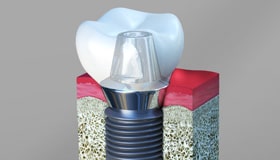
A crown covers the visible portion of the tooth to help restore shape, strength, and function. Crowns are often chosen when the tooth has lost substantial structure, has deep cracks, or has been weakened in ways that make partial coverage too risky.
If you are also comparing dental crowns in Cathedral City, our dental crowns page explains what crowns are and how the restoration process works.
When a Crown May Be the Safer Choice
- Major tooth breakdown (large portions of the tooth are missing)
- Fractures that extend into areas that need full-coverage reinforcement
- Teeth that have had root canal treatment and need added protection (case-dependent)
- Heavy bite forces or grinding where full coverage reduces risk
A Few Simple Scenarios Patients Recognize
"My Filling Fell Out Again"
If a tooth has been filled multiple times, each replacement can remove more structure. When the remaining tooth gets thinner, a restoration that reinforces the chewing surface (like an inlay/onlay) or covers the tooth (like a crown) may be considered to reduce the chance of a fracture.
"I Have a Big Cavity, But I Want To Keep My Tooth as Natural as Possible"
This is exactly where inlays and onlays can be a useful middle option. The goal is to restore strength and contact points while keeping healthy enamel whenever it is reasonable to do so.
"A Piece of My Back Tooth Chipped When I Bit Something Hard"
Small chips may be treated with a filling, but if a cusp is compromised, reinforcing that area can matter. The decision depends on crack depth, where the chip is located, and how your bite hits that tooth.
What To Ask at Your Exam (So You Understand the Recommendation)
If you are choosing between dental fillings in Cathedral City, an inlay/onlay, or a crown, these questions help you get a clear, practical explanation:
- How much healthy tooth structure is left? Ask what you have to "build on."
- Are there any cracks? Even small cracks can change the best option.
- Where are the stress points when I bite? Chewing forces matter, especially on back teeth.
- What is the conservative option, and what makes it risky (if it is)?
- What maintenance do you recommend? Nightguard, cleaning schedule, and checking margins.
FAQs
A filling is often appropriate for small-to-moderate decay. An inlay may be recommended when a cavity is larger, when an old filling is failing, or when the tooth needs stronger support in the chewing surface area but does not need full-coverage like a crown. Your dentist confirms this by examining the tooth and reviewing X-rays.
An inlay typically fits within the cusps (the pointed parts) of a back tooth. An onlay extends over one or more cusps. Both are designed to restore strength and function when a simple filling may not be enough.
Crowns provide full coverage and can be the safer choice when a tooth is significantly weakened, fractured, or has extensive decay. Inlays and onlays can still be very strong, and they may preserve more natural tooth structure when full coverage is not necessary. The best choice depends on how much healthy tooth remains and how the tooth is biting.
Many inlays and onlays are completed in two appointments: one for evaluation, preparation, and impressions, and a second to place and adjust the final restoration. Your dentist will review the expected timeline for your specific tooth and materials.
Ask how much tooth structure is missing, whether any cracks are present, how your bite forces affect the tooth, what material is recommended, and what the long-term maintenance looks like. It is also reasonable to ask why a more conservative option would or would not be appropriate for your situation.
Related Reading
Conclusion: The Right Restoration Should Match the Risk
If your tooth needs repair, the best next step is a diagnosis that looks beyond the cavity itself: bite forces, cracks, and how much strong enamel remains. A filling can be ideal for smaller repairs, inlays/onlays often fit when the tooth needs more support without full coverage, and crowns are often reserved for teeth that need maximum protection.
If you are comparing options and want a clear recommendation you can understand, call Smile Guru at 760-318-4400.
Ready to decide between a filling, an inlay/onlay, or a crown? Call 760-318-4400 or request an appointment.
Schedule an AppointmentFor an overview of our full restorative and preventive options, you can also visit our dental services.