Inlay vs. Crown: How Dentists Choose the Best Fix
If you have a tooth that is cracked, heavily filled, or has a larger cavity, it can be confusing to hear different options: filling, inlay, onlay, or crown. Patients who search for dental crowns in Cathedral City are often trying to answer one simple question: "Do I really need a crown, or is there a more conservative way to fix this tooth?"
This guide explains how dentists typically decide between inlays, onlays, and crowns, and how porcelain options can restore strength and a natural appearance.
TL;DR - Inlay, Onlay, or Crown?
The best restoration depends on how much healthy tooth remains, where the damage is, and how much chewing force that tooth takes.
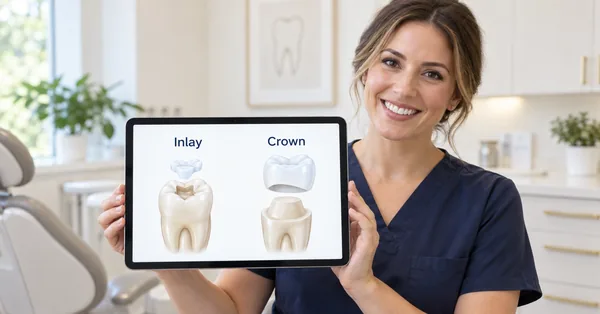
- Inlays fit inside the grooves of a tooth when damage is too large for a filling but cusps are mostly intact.
- Onlays cover one or more cusps when a chewing surface is weakened and needs extra protection.
- Crowns cover the entire tooth when cracks, large fractures, or extensive decay make full coverage the safer choice.
- Porcelain options can look natural, especially when shade and shape are planned carefully.
In our previous blog, "5 Benefits of Regular Dental Cleaning | Cathedral City", we discussed why prevention helps avoid bigger restorations. In this article, we focus on how to choose the right restoration once a tooth needs more than a routine filling.
What Are Inlays, Onlays, and Crowns?
Inlays: A Custom Fit Inside the Tooth
An inlay is a custom restoration that fits into the chewing surface of a back tooth (usually a premolar or molar). Think of it as "bigger than a filling, smaller than a crown." It is typically considered when a cavity or old filling is too large for a standard filling to hold up well.
Onlays: A Step Up When Cusps Need Coverage
An onlay is similar to an inlay, but it also covers one or more cusps (the pointed parts you chew with). When a cusp is thin, cracked, or undermined by decay or an old restoration, covering it can help reduce the risk of the tooth breaking.
Crowns: Full Coverage Protection
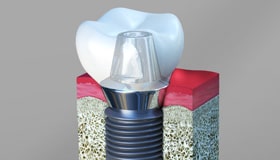
A dental crown covers the entire visible part of the tooth above the gumline. When there is significant damage, a crown can provide more complete reinforcement than an inlay or onlay.
If you are exploring dental crowns in Cathedral City, it usually means your tooth needs strength and coverage, not just a cosmetic touch-up.
Inlay vs. Crown: The Decision Points Dentists Use
The choice is not about which restoration is "better" in general. It is about which option best matches the condition of your tooth and your bite.
1) How Much Healthy Tooth Structure Is Left?
- More healthy enamel can make an inlay or onlay a conservative option.
- Less healthy tooth remaining often shifts the recommendation toward a crown for full coverage and support.
2) Are the Cusps at Risk of Fracturing?
If damage is mostly inside the tooth, an inlay may be enough. If a cusp is involved, an onlay (or crown) can be recommended to reduce fracture risk.
3) Is the Tooth Cracked or Heavily Restored?
Cracks and very large old fillings can change the equation. In many real-world situations, the more compromised the tooth is, the more likely full coverage (a crown) becomes the safer long-term plan.
4) Where Is the Tooth in Your Mouth?
Back teeth often experience heavier bite forces. That matters when choosing between a larger bonded restoration and a full crown. Your bite, grinding habits, and existing restorations all factor in.
How Porcelain Restorations Fit In (Inlays, Onlays, and Crowns)
Porcelain can be used for inlays, onlays, and crowns and is often chosen for its natural-looking appearance. If you have been researching porcelain crowns in Cathedral City, you may also be a good candidate for porcelain inlays or onlays depending on the tooth.
Learn more about these conservative options on our porcelain inlays and onlays page.
When an Inlay or Onlay May Make More Sense Than a Crown
Inlays and onlays are often considered when the goal is to restore a damaged area while preserving as much healthy tooth structure as possible.
- The cavity is too large for a simple filling, but the tooth is not severely weakened.
- A cusp needs targeted coverage (often an onlay) rather than full coverage.
- You want a custom restoration that fits precisely and is designed to handle chewing forces.
When a Crown Is Often the Safer Choice
Crowns are commonly recommended when the tooth needs "full-coverage" reinforcement.
- There is extensive decay, a large fracture, or a tooth has a history of repeated breakdown.
- The tooth has a crack pattern that suggests it needs more overall protection.
- The bite forces on that tooth are high, making partial coverage riskier.
If you also need to understand how crowns fit into overall care, our general dentistry services page gives a broader view of restorative options.
What Patients Commonly Feel After These Restorations
A little bite adjustment sensitivity or temperature sensitivity can happen after any new restoration, especially if the bite needs fine-tuning. One experience-based observation our team sees often is that patients may interpret "high bite" (a restoration hitting first) as tooth pain. A quick adjustment can make a big difference in comfort.
If you ever feel sharp pain when biting after a restoration, call promptly so your dentist can check the bite and evaluate the tooth.
FAQs
In many cases, yes. An inlay is a custom restoration designed to fit a larger damaged area than a typical filling. Strength depends on the material, tooth condition, and bite forces, so an exam is the best way to confirm what will hold up well for you.
An onlay is often considered when damage extends onto one or more cusps (the pointed chewing surfaces). If a cusp is weakened, covering it can reduce the chance of fracture compared with restoring only the inside of the tooth.
A crown may be recommended when there is extensive decay, cracks, large fractures, or a tooth has been significantly weakened. A crown covers the entire visible portion of the tooth, which can provide more overall protection in higher-risk situations.
Porcelain restorations are commonly chosen because they can be color-matched to blend with your natural tooth. The final look depends on shade selection, tooth shape, and how much natural enamel is available for blending.
Longevity varies by bite forces, habits like clenching, oral hygiene, and how much tooth structure is healthy. Your dentist can estimate expected lifespan after evaluating your tooth and discussing risk factors and maintenance.
Related Reading
- Dental crowns
- Porcelain inlays and onlays
- Dental fillings
- Our dental office
- Cosmetic dentistry services
Conclusion: The Right Restoration Protects the Tooth You Have
Choosing between an inlay, onlay, or crown is really about risk management: how to restore your tooth while reducing the chance it breaks again. For some teeth, a conservative porcelain inlay or onlay is a great fit. For others, a crown provides the protection the tooth needs.
If you are deciding between these options and want guidance specific to your tooth and bite, Dr. Keerthi Senthil and our team at Smile Guru are here to help.
Ready to talk through your options for restoring a damaged tooth? Call us at 760-318-4400 or request an appointment.
Schedule a Consultation